
Validate structural integrity under launch loads. Sinusoidal sweep, random vibration, and shock tests to qualification and acceptance levels — across all three axes.
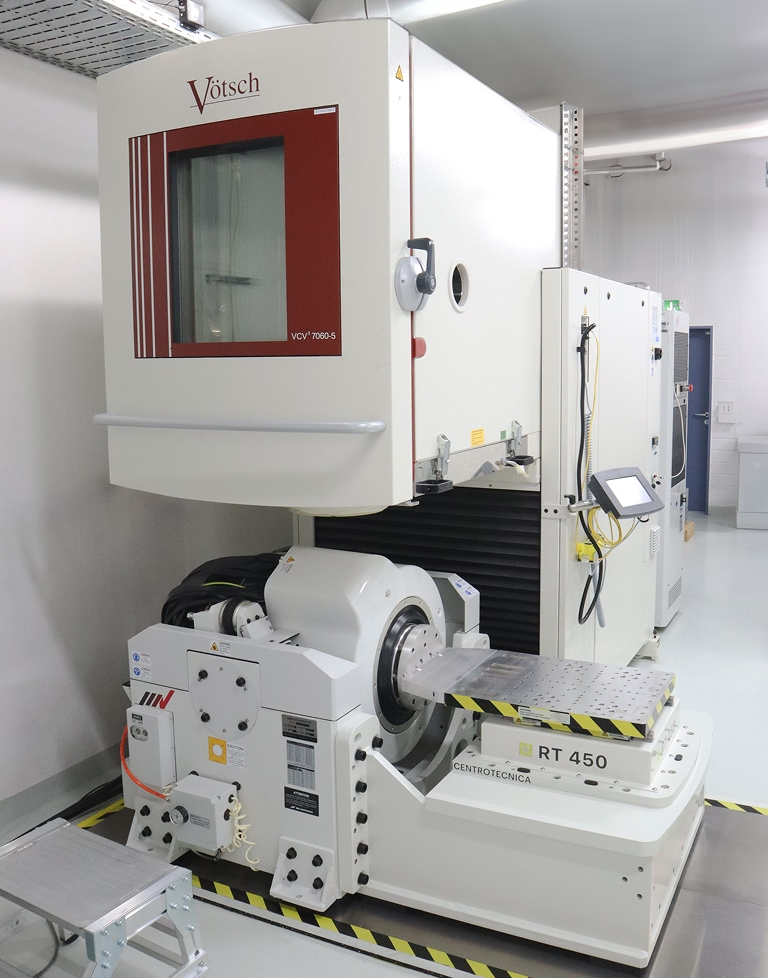
Three shaker setups (30 kN + 22 kN + 22 kN). Mechanical shock up to 150 g. Sine, random, and shock — all axes, all levels.
Sine, random, shock, sine burst, and HALT/HASS — coordinated in a single qualification or acceptance sequence.
Sinusoidal sweep across the launch frequency band. Detects resonances and validates structural margins. Three-axis testing per ECSS qualification matrix.
Broadband random excitation simulating launch acoustics and engine vibration. Levels per launch provider’s coupled load analysis or ECSS margin policy.
High-G shock testing for separation events, deployment, and pyrotechnic environments. Up to 150 g on the operational shaker setup.
Quasi-static load simulation for primary structure qualification. Replaces centrifuge testing for many CubeSat-class structures.
Highly Accelerated Life Test and Stress Screening — combined thermal and vibration stress to find weak points before flight.
Most CubeSat campaigns combine sine, random, and shock in a single coordinated 3-axis sequence. We schedule and document as one campaign.
Multiple shaker systems allow parallel vibration and shock campaigns with shorter scheduling lead times.
Three shakers with overlapping capability means we schedule campaigns on the right shaker, not the only one available. That’s how 4–6 campaigns per month is realistic, not aspirational.
Fixtures are CubeSat-optimised — no oversized adapters, no extra mass, no unnecessary modal complexity in your test article.
Accelerometer count, control strategy, and notching policy are agreed in the test plan — not improvised at setup time.
Test levels per customer requirement or ECSS margin policy. Final levels confirmed in the test plan.
European space standard covering qualification and acceptance test levels for vibration, shock, and acoustics. Default reference for European launch.
European space standard covering qualification and acceptance test levels for vibration, shock, and acoustics. Default reference for European launch.
Test levels driven by launch provider coupled load analysis (CLA) or NASA GEVS — applied directly when specified by the mission.
Vibration campaigns are a core part of environmental qualification for aerospace hardware.
The following test types are regularly scheduled for launch and flight verification programs.
3-axis sine + random vibration on fully integrated 1U–16U platforms before flight delivery.
Vibration qualification of OBC, EPS, ADCS, and propulsion modules at margin levels.
Shock and vibration testing of separation switches, hold-down release, and deployment hardware.
Survival and pointing verification under launch loads for cameras, telescopes, and IR sensors.
Vibration is rarely the only test in a qualification campaign — these are commonly paired.
Survive the orbital thermal environment.
Electromagnetic compatibility.
Verify behaviour after vibration exposure.
Full qualification under one roof.
Tell us your hardware, your launch date, and your CLA levels. We’ll confirm slot availability and scope the campaign within days.
Five modes: sine vibration (sinusoidal sweep across the launch frequency band), random vibration (broadband excitation simulating launch acoustics and engine vibration), mechanical shock (separation, deployment, pyrotechnic environments — up to 150 g), sine burst (quasi-static load for primary structure), and HALT/HASS (combined thermal + vibration stress screening).
All three axes, qualification and acceptance levels.
Three shakers running in parallel: 30 kN (large slip table), 22 kN (vertical/horizontal), and 22 kN (backup/parallel). Mechanical shock up to 150 g. Frequency range 5 Hz – 2000 Hz. Multi-channel control and monitoring.
Three shakers with overlapping capability is what makes 4–6 campaigns per month realistic — not aspirational.
ECSS-E-ST-10-03C — European qualification and acceptance test levels for vibration, shock, acoustics. Default reference for European launch.
MIL-STD-810 — Environmental engineering.
NASA GEVS or your launch provider’s Coupled Load Analysis (CLA) when mission-specific levels are required. Final levels are confirmed in the test plan, not improvised at setup.
Yes — and most CubeSat campaigns are. Sine, random, and shock in a single coordinated 3-axis sequence. We schedule on the right shaker, not the only one available, and document the full sequence as one campaign report.
Sine burst replaces centrifuge testing for many CubeSat-class primary structures.
Yes. Fixtures are CubeSat-optimised — no oversized adapters, no extra mass, no unnecessary modal complexity in your test article. Accelerometer count, control strategy, and notching policy are agreed in the test plan, not improvised at setup.
Custom fixtures are part of the scope when needed.
2–4 weeks from confirmed slot. Three shakers and overlapping capability mean we schedule on the right machine, not the only one free.
Tell us your hardware, your launch date, and your CLA levels — we confirm slot availability within days.